AI investing apps · by Capacitr
AI investing apps for people who plan to hold
Investing is not day trading. If you are building positions over months or years, the AI features that matter are different: how a portfolio is built, what it costs every year, who regulates the adviser and where your money sits. Here is how six apps compare on those terms.
Free on iOS 16.4+, Android and the web. Not financial advice. Trading involves risk of loss.
Updated November 7, 2026
Four styles of AI investing
Pick the style before the app
Thesis-to-portfolio
You describe a view, such as “AI power demand grows,” and the app builds a basket. Supertake works this way, placing orders at your own broker.
Copy investing
You follow a published strategy or a disclosed set of trades. Autopilot mirrors portfolios based on experts, 13F filings and politicians’ disclosures, which lag the original trades.
Bring-your-own AI at a broker
Your AI assistant connects to a regulated brokerage. tastytrade offers this through an official MCP server with order previews.
News-aware research
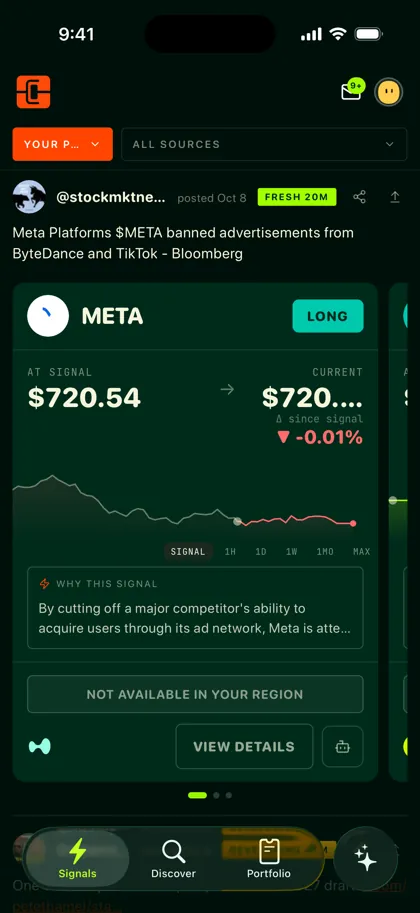
The app watches the news and tells you which holdings or markets a story affects. Capacitr and Button take this approach and leave the decision with you.
For investors
AI investing apps compared on what lasts
Long-term investors should weigh regulation, custody and recurring cost above speed. Checked November 7, 2026.
| App | How AI is used | Stocks | Regulation and limits | Custody | Pricing |
|---|---|---|---|---|---|
| Capacitr Our app | News-to-trade assistant: matches breaking posts and articles to the markets they move, writes a thesis with sources and can fill in a ticket. | Tokenized US stocks via Robinhood Chain (EU/EEA) and Base. | Not an exchange. Venue limits apply: Hyperliquid is not available in the US or Canada, new Polymarket positions are not available in the US or UK, Robinhood Chain is EU/EEA only. | Self-custodial wallet. Capacitr does not hold funds. | Free app. Venues charge their own fees. |
| Supertake | Turns a plain-English investing thesis (a “take”) into a portfolio. Takes can be shared and forked. | Yes: thesis-driven stock and ETF portfolios at your broker. | Says it is not a broker-dealer, investment adviser or SIPC member. | Funds stay at your connected broker (Robinhood and Coinbase are named). | No subscription or commission for now; it says fees may be added later. |
| Catalyst | Autonomous agents turn a plain-English strategy into a workflow that watches signals and trades. | Tokenized stocks only. | States it is not registered with the SEC as an investment adviser or with the CFTC as a commodity trading advisor. | Non-custodial wallets (via Privy). Withdrawals in stablecoins only for now. | Free during its research preview. Later pricing not stated. |
| tastytrade | No built-in agent. An official MCP server lets an AI assistant you bring (such as Claude) read your account and send orders. | Yes: full brokerage for stocks, ETFs and options. | Registered broker-dealer; member of FINRA, NFA and SIPC. | Held at the broker. Crypto held by Zero Hash. | $0 stock trades; options $1 per contract to open (max $10 per leg), $0 to close; crypto 1%. |
| Autopilot | Mainly copy-trading portfolios (“Pilots”) that track experts, 13F filings and politicians, plus AI portfolios. | Yes: copy portfolios of stocks and ETFs. | Advice from Autopilot Advisers, LLC, an SEC-registered investment adviser. | Funds stay at your broker (Robinhood, Schwab and Public are named). | Free tier; premium reported at $29 a quarter or $100 a year (May 2025 press; current pricing not verified). |
| Button (Tailor) | AI research assistant that analyzes your portfolio and data, runs scheduled briefs and risk scans, and drafts trades. | Stocks mentioned; details not published. | Not published. | Not published. | Not published. |
What it really costs
Fees compound too
A subscription that looks small can matter on a small account. A $100 yearly fee on a $5,000 portfolio is 2% a year before any trading costs, which is more than many index funds charge in a decade.
Look at three layers: the app fee (subscription or free), the trade fee (commissions, spreads or a percentage on crypto) and the venue or fund fees underneath. Several apps on this list are free during a preview or beta and say pricing may change.
Leveraged products such as perpetual futures are generally a poor fit for buy-and-hold investing. Capacitr reaches perps, prediction markets and tokenized stocks; if you only want a long-term stock portfolio, a thesis or copy-investing app at a regulated broker may suit you better.
About our app
How Capacitr works
Capacitr is our app. It is built for acting on news rather than for passive portfolios, and here is exactly what it does. Based on its App Store listing and support page.
Self-custodial
Capacitr is not an exchange, does not hold your funds and is never the counterparty to your trades. You approve a trading key for your own wallet, and every fill links to the venue’s explorer.
Asks before it signs
The assistant can suggest a trade and fill in the ticket. Nothing is placed until you confirm, and Capacitr tells you what is sent to its AI providers before your first question.
FAQ
Common questions
What is the best AI investing app for beginners?
For a long-term stock portfolio, look for an app that keeps money at a regulated broker and explains every change. Autopilot (SEC-registered adviser) and Supertake (orders at your own broker, invite-only) fit that pattern. Capacitr, which publishes this guide, is better suited to people who want to act on news.
Do AI investing apps hold my money?
Supertake and Autopilot connect to a broker you already use. tastytrade is the broker. Capacitr and Catalyst use self-custodial wallets. Button has not published custody details.
Are AI investing apps worth the fees?
Only if the fee is small relative to your account and the app does something you would not do yourself. Compare the yearly fee as a percentage of your balance.
Can I copy politicians’ trades with an AI app?
Autopilot offers portfolios based on congressional disclosures. Those filings are delayed, so copies lag the original trades.
Who wrote this guide?
Capacitr, Inc., maker of the Capacitr app. Facts about other apps come from their own public pages, linked below.
Read the news. Trade what it moves.
Try Capacitr
See the market a story moves, read the reasoning and decide for yourself. Learn more at capacitr.xyz.